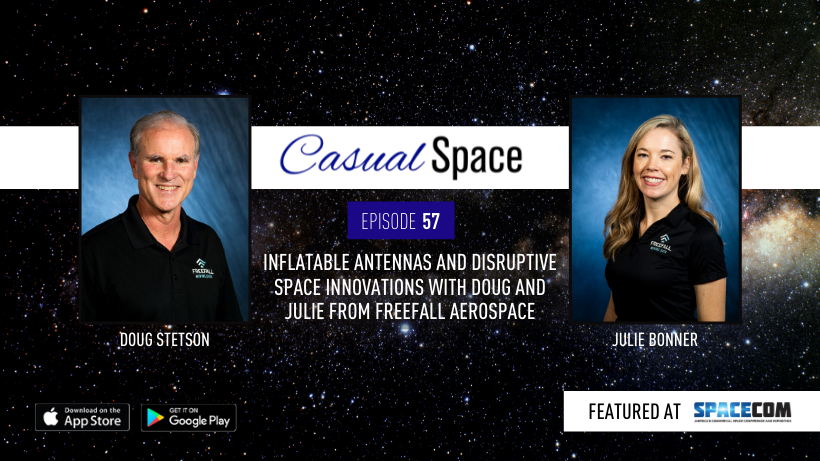
Inflatable Antennas and Disruptive Space Innovations
Doug Stetson and Julie Bonner from FreeFall Aerospace on Casual Space Podcast with Beth Mund
When we travel through and explore space, we’re going to need to communicate, and gather a LOT of data. Fast, reliable, low-cost access to large volumes of data is one of the most critical capabilities that will define the future. Freefall Aerospace is providing antennas that help move data and allow us to communicate effectively and quickly in space. Julie Bonner and Doug Stetson sat down with Beth Mund at SpaceCom Expo in Houston, Texas and highlighted these new technologies, why and how they will “disrupt” and improve communications, and what some of the challenges their company, FreeFall Aerospace, will have to overcome, including a LAUNCH in January 2021.
LISTEN TO THE PODCAST BELOW
“We are developing some very innovative technologies. That’s a good thing, but one of the challenges is that when you have something that’s what we call disruptive, it has to be not just a little bit better, but a LOT better than the other systems that people and companies are used to using…and it’s a question of proving to the community that the rewards of using this type of new system are worth the additional risk to implement something new.” -Doug Stetson
Doug Stetson: President and CEO
Beth Mund: Host of Casual Space
Beth delivers contagious enthusiasm and unabashed space geekery, drawing on her experience as the former Public Affairs Officer for NASA and more than 20+ years of speaking and executive speech writing.
From US Space Camp attendee to Space Academy instructor, Beth’s passion for space exploration and future- forward innovations has never waned. As an International Space Station Communications Officer and official NASA spokesperson – the first person answering the phones during the Columbia disaster – Beth faced the task of conveying highly technical information in a way that was relatable, clear, and human.
Since then, Beth has gone on to wow audiences across the nation with her captivating keynotes and workshops, bringing listeners on a journey through the final frontier, leaving them filled with wonder, enthusiasm, and inspired ideas to implement within their own organizations.
As the host of the weekly podcast, Casual Space, Beth is dedicated to bringing the stories from the space exploration industry to her ever-growing community of students, businesses, investors and space enthusiasts. Beth’s guests include engineers, authors, astronauts and industry leaders, sharing space exploration events and perspectives with listeners from around the world.
Julie Bonner: Marketing Director
Julie Bonner, Marketing Director for FreeFall Aerospace, connects partners, vendors, and investors to FreeFall’s intelligent antenna systems. She’s created marketing campaigns and collateral for national corporations like Mister Car Wash and Clear Channel Outdoor, to Tucson-based start-ups and non-profits. She has been awarded the Tucson AdFed Next Generation Award for making a significant impact on the advertising industry through leadership, career achievements and personal qualities, which also inspire others to excel. She is also active in Start-Up Tucson, Arizona Technology Council and Local First Arizona. Julie holds a Bachelors of Science in Graphic Design from Drexel University and a Masters in Business.